Wednesday, October 27, 2021

Restless Natives


Hi reader

Today I'm reporting from Glasgow, and although I've been here a few days, I haven't done any actual sightseeing as yet. I've been staying in one of the city's nicer suburbs, Milngavie. My parking spot isn't very scenic, but it's quiet and it feels safe. I've been staying in the car park of an Aldi supermarket.


A week or so ago, I watched one of my favourite films, Restless Natives (1985). I first saw it on video when it was quite a new release, and I've watched it many times since. I always loved the modern day Robin Hood theme of this comedy, action adventure set in Scotland.


The Premise

The story follows the adventures of two Scottish youths from the Wester Hailes district of Edinburgh. Ronnie (played by Joe Mullaney) and Will (played by Vincent Friell) rebel against their drab lives in urban Scotland in the mid-1980s and become modern highwaymen. Donning masks of a clown and a wolf-man and riding a Suzuki GP 125 motorbike, they waylay and rob tourist coaches in the Scottish Highlands using a toy gun. In the process they become a tourist attraction themselves. They proceed to become heroes, doling out money to the poor of their city by scattering it on bike rides through its streets.


Music Score

I love the music in this film and it really suits the drama and action of the story. The soundtrack features music from the band Big Country. It wasn't released on an album but was combined into two lengthy tracks, each featuring various pieces of music and clips of actors from the film's audio, which appeared on limited edition formats of two Big Country 12" singles. The soundtrack was released on CD for the first time on the 1998 Big Country collection Restless Natives & Rarities, where it is presented as a single 35-minute track.


Alone among the hills and stone
Through summer sun and winter snow
The eagle he was lord above
And Rob was lord below

Sighthill Cemetary

Although the film is set in Edinburgh and the Highlands, a lot of it was actually filmed here in Glasgow. For example, Hardwick's Joke Shop, where Ronnie works, was filmed in a shop which is now part of Glasgow's Radisson Hotel.


Yesterday I set out to Sighthill Cemetery to find a gravestone where some of the film's key scenes were filmed. The problem - the cemetery covers 46 acres of land. I'd done some online research and I had screenshots from the film to help me home in on the filming location.

In the story, Ronnie comes to this gravestone to air his thoughts and feelings whenever he wants to be alone. He talks to the gravestone about things he can't tell anyone else, including his new life as a criminal.
 
Sighthill Cemetery opened in 1840, and stands on a hill 400 metres above sea-level. It offers panoramic views of the surrounding area. My friend, Jimmy, warned me that Sighthill isn't one of the city's nicer areas, and I might find myself confronted by a gang of 'neds' (non-educated delinquents). But I pretty much had the cemetery to myself as I wandered between the rows of headstones, trying to match the view to the screenshots on my phone.


And after half an hour or so, I found it!


Cool Movie Trivia

Spoiler alert! The last time we see the friends at the grave, Ronnie reveals to Will that he isn't related to the person buried in the grave at all. He just adopted a random grave and he's been sharing his innermost thoughts with a random unknown all this time. Here's the scene:


Ronnie: You just haven't got a clue, have you? What does that say?
Will: Beattie
Ronnie: Right. So what's my name?
Will: Ronnie. Ronnie Witherspoon!
Ronnie: Look, I don't know who's down there. I just picked him.

And ... the name on the gravestone really is Beattie! I love that. 

Sacred to the memory of William Beattie.


Oh and the final scene as the film's credits roll, shows Ronnie, Will and Will's girlfriend, Margot, standing on the peak of Arthur's Seat in Edinburgh, which I visited five days ago.


As my friend, Gideon, said, this is probably just a post for one person. Most people haven't heard of Restless Natives and it's kind of a forgotten eighties classic. If you haven't seen it, treat yourself and watch it. It's such a fun film. 80% rating on Rotten Tomatoes! Maybe this review from the Guardian will convince you. 

Enjoy!

Time for some dinner

After Sighthill Cemetery, I headed to College Street and reunited with my friends from Bangkok, Lori and Adrian and my favourite French bulldog, Jimmy.


These guys have got such a lovely flat in the city centre and it was great to catch up. Jimmy was high energy and I felt sure he could remember me from Bangkok. He looked very stylish in his winter fleece.


Lori made us a lovely vegan dinner. We had bruschetta followed by spaghetti bolognaise. Sorry, forgot to get pics of the spaghetti, but it was delicious. Thanks so much, Lori.


Around half past eight, I said cheerio, headed back to the van and drove back out to Milngavie to watch another favourite film, One Flew Over the Cuckoo's Nest. 

Good night, Jimmy!


Today I've got another dinner invite from past British Council colleagues; I'm being spoiled in Glasgow. First though, time for some sightseeing.

Thanks for reading,

Brian

Tuesday, October 26, 2021

Dean Village


Hi reader,

Fifty today. Fifty days of living in my van and fifty posts on this blog. 

For my last day in Edinburgh I decided to take it easy. The temperature was mild and the sun came out, so after a quick return visit to Glenogle Swim Centre for a shower and shave, I headed to the Dean Village.

It's hard to believe that this place was once one of Edinburgh's slum areas.

Dean Village is a peaceful village on the Water of Leith, Edinburgh's largest river. It has a history that stretches back over 800 years. Founded during the twelfth century by the Canons Regular of Holyrood Abbey, it is also known as the Water of Leith Village. In the past, the area had eleven working mills on the strong currents of the city's river.

Amazingly, this part of Edinburgh which has seemingly been lost in the past is only a short walk from Edinburgh's city centre. My mum loves old buildings and I know she'd love to stroll around these cobbled streets.

The ochre yellow buildings along the river bank were built in 1675.


I had to step carefully on the wet cobblestones; they were quite slippery.


Here's the view looking back at the arched bridge at the entrance to the village. Back in the day, carts had to pay a toll to cross the bridge.


On the wall by that bridge are two carved stones. This 1643 datestone with crossed peels, and an inscribed lintel.


The writing on the lintel is so faded it's very difficult to read. It says 'Blessit Be God For Al His Giftis'


At one side of the bridge is the oldest house in the village. It dates from the 17th Century and was restored by Sir Basil Spence for the artist, Aleksander Zyw.

Here's another view from the side of the house. Someone still lives in there.


The most striking building in Dean Village is Well Court, which was commissioned in the 1880s by Sir John Ritchie Findlay, who was then the owner of The Scotsman newspaper. 


An older gentleman who gave me directions to Dean Village told me to look out for stone plaques with the initials JRF (John Ritchie Findlay) and SL (his wife, Susan Leslie). And sure enough, there were quite a few. Here's the one above the entrance to Well Court: JRF ... SL ... 1884.


This is John Ritchie Findlay.


Well Court has now been converted into modern flats. I imagine it must cost a bomb to own or rent one.


This is the village school, which opened in 1875 and closed in 1961.


This roundel shows Margaret (Malcolm III's Queen 1070-1093) teaching a child.


And just across the road from the school is this children's playground which was also the schoolyard back in 1875 when the school opened.


If you keep your eyes open as you walk around the Dean Village you might spot this Victorian era postbox. 


VR = Victoria Regina (Regina being the Latin word for queen). British post boxes were first built into existing walls like this in 1857. Although green was the standard colour at first, boxes began being painted red in July 1874, a process which took 10 years. I'm not sure how many of these VR post boxes are still to be found in the UK, but after some Googling I found 19 in Scotland.

As I headed back to my van, I passed the Baxter's Tollbooth, which was built in 1675.


It was headquarters to the Incorporation of Baxters (or bakers), and their granary. The carvings over the old door include crossed peels, loaves of bread  and the inscriptions 'God's Provedenc is our Inheritens' and 'God Bless the Baxters of Edinbrugh Uho Bult This Hous 1675'. 

I used Google maps to find a good vegan restaurant. There are loads to choose from in Edinburgh and I went for Holy Cow on Elder Street. This is the quarter pounder vegan burger with potato wedges and it was awesome. Delicious and filling. I got talking to some people on the next table who had also been to the Ray Harryhausen Exhibition yesterday.


Then it was back to Marine Drive for my final sleep in Edinburgh. This afternoon I'm in Glasgow and I'm taking it easy. It's quite cold and rainy outside, so I'm happy to be in the Milngavie Community Library. Weirdly, Milngavie isn't pronounced 'Miln-gah-vee'. My Glaswegian friend, Jimmy, tells me I should say 'Mil-gai'. Go figure. 

Thanks, as always, for reading. More soon.

Brian


Monday, October 25, 2021

Release the Kraken

Hi reader

Yesterday I went to the Scottish National Gallery of Modern Art to see the Ray Harryhausen exhibition. This was a huge treat for this movie fan who grew up in the age before CGI when some of cinema's most terrifying monsters were created using stop motion animation. 

Ray Harryhausen's influence on today's filmmakers was enormous, with luminaries; Steven Spielberg, James Cameron, Peter Jackson, George Lucas, John Landis and the U.K.'s own Nick Park having cited Harryhausen as being the man whose work inspired their own creations. He was a titan of cinema!

Social distancing is still very much in place in Scotland, so attendance numbers were limited. This was in my favour as it gave me plenty of opportunities to get close to the various models Ray Harryhausen used to bring his ideas to life, as well as lots of other fascinating artifacts from his life and career.

The exhibition begins with a room dedicated to King Kong (1933), the film which inspired Harryhausen to begin experimenting in the production of animated shorts. 

The scenes utilising stop-motion animation featuring creatures on the island or Kong, were the work of pioneer model animator Willis O'Brien. His work in King Kong enthralled Harryhausen, and a friend arranged a meeting with O'Brien for him. O'Brien critiqued Harryhausen's early models and urged him to take classes in graphic arts and sculpture to hone his skills.

While still at high school, Ray Harryhausen made marionettes so that he could recreate some of his favourite scenes from King Kong and other films of the time.

And here are some of his tools for creating concept art and models.


From a young age, Ray Harryhausen was fascinated by prehistoric monsters. It was a passion he shared with his lifelong friend, the writer Ray Bradbury. This is an early model of a triceratops Harryhausen made using a metal skeleton and latex rubber covering. 


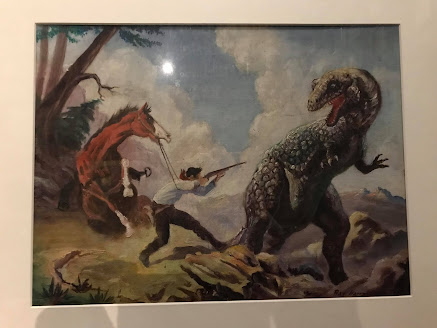
Willis O'Brien had instilled in Harryhausen the importance of planning his models using drawings. Something I learned at this exhibition is that Ray Harryhausen was also a talented artist. He did this picture showing a cowboy fighting a dinosaur when he was just nineteen years old.


And many years later, this concept of cowboys VS dinosaurs would come to life when he worked on The Valley of Gwangi. It was made the year I was born, and I saw it on TV when I was quite young. I thought it was amazing; there were always cowboy films and shows on TV in the 1970s but this was the first time I'd seen a cowboy film that had dinosaurs in it.


Early in the film, we see a rodeo show that has a very special star attraction: a tiny horse called El Diablo. It is, in fact, a prehistoric Eohippus, captured in a place known as the forbidden valley. Here is Ray Harryhausen's concept sketch for the Eohippus:


And imagine my surprise and joy when I looked around the next corner and there it was - El Diablo!


This is the actual model used in the film. I haven't seen it since it was on my tv screen in the 1970s.

And here's the title character himself, Gwangi, A vicious Allosaurus who rules the forbidden valley.


The Valley of Gwangi is a parallel Kong story. The cowboys eventually capture Gwangi and bring him to the nearest Mexican town for exhibition. You can guess how this story plays out.

Another thing I learned at the exhibition is that Ray Harryhausen worked alone in creating the majority of his animations. It was only in his final movie, Clash of the Titans (1981) that he had animation assistants. Here, cast in bronze, are the hands that made all those creatures come to life.


This is Harryhausen's typewriter, which he used to write the scripts for his action sequences. There's a Clash of the Titans headed paper in the reel.


One of Ray Harryhausen's most celebrated and memorable films is Jason and the Argonauts (1963). Although it was a box office disappointment during its initial release, the film was critically acclaimed and later became a cult classic.

When Jason and his crew of Argonauts travel to the Island of Bronze, they meet the giant bronze statue of Talos. The statue comes to life and attacks the Argonauts.


And I had my own terrifying encounter with Talos ...


... through the magic of the exhibition's green screen room!


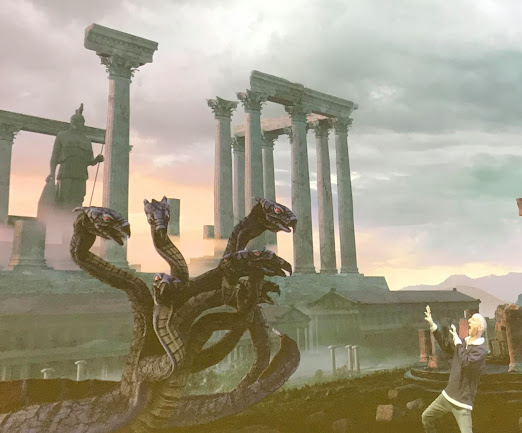
Later, Jason and his men land on the island of Colchis, where they hope to find the Golden Fleece. Unfortunately, the treasure is guarded by the deadly seven-headed Hydra. Here's some more of Harryhausen's amazing concept art.


Aieeee! It's here! The Hydra!


Ho ho. Don't worry, reader. Just more green screen trickery.

Even with the Hydra defeated, Jason's trials aren't over. King Aeëtes sows the Hydra's teeth and prays to the goddess Hecate. Seven sword-wielding skeletons, the 'children of the Hydra's teeth', emerge from the ground. This is surely one of the most iconic climactic battles in cinema history. 


The model skeletons are much smaller than I expected. They're only about 6 inches tall, yet they look so amazing in the film as they battle Jason and friends.


"Destroy them! Kill them all! Kill, kill, kill them all!"


Describing the scene, Harryhausen said "I had three men fighting seven skeletons, and each skeleton had five appendages to move in each separate frame of film. This meant at least thirty-five animation movements, each synchronized to the actor's movements. Some days I was producing just 13 or 14 frames a day, or to put it another way, less than one second of screen time per day, and in the end the whole sequence took a record four and a half months to capture on film."


Harryhausen's career also brought us three Sinbad films. Growing up, I thought there were many more, but I now realize I must have just been seeing the same three films over and over again. 

A memorable scene from The Golden Voyage of Sinbad (1973) saw our hero fight the six-armed living statue of Kali, brandishing a sword in each hand. Here's the model of Kali.


In Sinbad and the Eye of the Tiger (1977), I was always frightened of the Minoton, a magical bronze automaton with the appearance of a minotaur. However it was all build up and no delivery. Throughout the film we saw the Minoton rowing a boat across the ocean, with menacing music playing. How on Earth would Sinbad possibly defeat this terrifying foe? The answer is, he didn't. As I recall, he never even met it. There was a scene where an evil sorceress ordered the Minoton to remove a giant block of stone from the side of a pyramid. The Minoton obeyed, lost its balance and toppled backwards to be crushed by the stone block. And that was it! What an anticlimax. Even as a kid I thought - what was the point of the Minoton even being in the film? I still thought it was a cool monster, but it seemed stupid to build it up throughout the story only to have it crushed by a big stone.


And so to Ray Harryhausen's final feature film, Clash of the Titans (1981). By this point, Harryhausen had honed his stop motion techniques to perfection, and this film contains an amazing array of fantastical creatures and monsters. 

All of the models from Clash of the Titans were included in the exhibition.


Here's one of the 'giant' scorpions.


And this is the wicked, Calibos. I found him terrifying!


This sequence of pictures shows the detailed planning that went into bringing the mythical, winged horse, Pegasus, to life for the movie.


This is one of Harryhausen's concept sketches for the gargantuan Kraken.


And this is the model.


A fan favourite from the movie was the mechanical owl, Bubo. Despite its similarities to Star Wars' R2D2, Harryhausen insisted he conceived and designed Bubo before Star Wars was released.


And for me, the most frightening adversary in Clash of the Titans was ... the Medusa! Be careful. Don't make direct eye contact.


Clash of the Titans was released in June of 1981 and made its budget back within weeks. Though it’s not considered to be Harryhausen’s best movie (most people prefer Jason and the Argonauts) it’s one of his most successful. It was one of the highest-grossing films of the year, and a re-release the following year only added to the popularity.


In 1991, Ray Harryhausen won the Gordon Sawyer award for technological contributions to the motion picture industry, and he received his Oscar trophy from the actor, Tom Hanks.

And in 2010 he also received a BAFTA for his 'unique and outstanding contribution to cinema'.

I had such a great afternoon reliving my childhood at this exhibition and I recommend it to any fan of the silver screen. The exhibition has been extended until Sunday the 20th of February 2022, so if you're visiting Edinburgh, be sure to check it out.

Thanks for reading,

Brian

Mission Completion

Hi, reader The home stretch, one more big push to get from Calais to Dover, was a real mission. I spent my last two nights in France in a lo...